





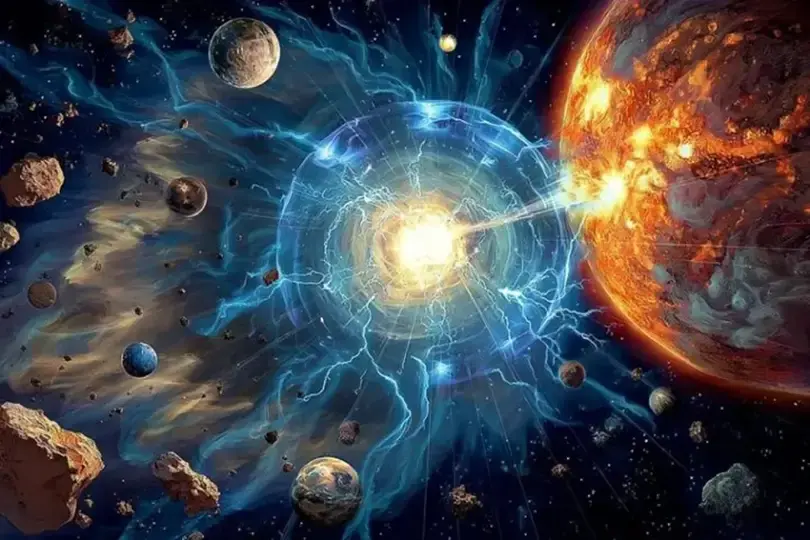
This Friday, November 7, Earth will be hit by a new wave of solar activity.
Space weather forecasters predict geomagnetic disturbances between levels 4 and 6 on the Kp index — strong enough for scientists to take notice, and sensitive people to feel the effects in their own bodies.
California’s skies may look calm, but even here the planet’s invisible weather — the magnetism that shields us from the Sun — will be shifting.
What Is a Magnetic Storm?
A magnetic storm is Earth’s reaction to solar flares.
When massive bursts of plasma erupt from the Sun’s surface — called coronal mass ejections — they send billions of charged particles racing through space at more than a million miles per hour.
Two or three days later, those particles slam into Earth’s magnetic field.
What happens next is invisible but real: Earth’s magnetosphere ripples and shakes. These fluctuations can disturb radio waves, GPS systems, and even human biology.
Scientists measure the intensity on a scale from 1 to 9.
A level of 4 to 6, like we’re expecting today, is considered moderate to strong — not catastrophic, but noticeable.
Why Our Bodies React
Our brains and hearts run on electricity. Every heartbeat, every nerve impulse is a tiny current. When Earth’s magnetic field wobbles, our own internal rhythms can feel it.
Medical researchers in the U.S. and Europe have found that during geomagnetic storms, hospitals see small but consistent increases in:
- headaches and migraines
- high or low blood pressure
- insomnia, anxiety, and irritability
- fatigue and loss of focus
NASA scientists call this bioelectrical stress — a subtle disruption that doesn’t cause illness by itself, but can amplify existing conditions.
What’s Happening on November 7
According to NOAA’s Space Weather Prediction Center, a solar flare classified as M-class — one of the more energetic types — erupted on November 4, sending a stream of charged particles toward Earth.
The Sun’s magnetic field in that ejection is oriented opposite to Earth’s, which means the two fields can connect — letting solar energy pour into our atmosphere.
By evening on the West Coast, the Kp index may hit level 6, strong enough to cause auroras in northern states and minor disruptions in communications and satellite systems.
California won’t see the auroras, but the planet’s entire magnetic shell will be stirred.
How It Affects Health and Mood
Physiologists explain it this way: magnetic disturbances activate the autonomic nervous system, which controls our heartbeat, blood pressure, and breathing — the functions we don’t consciously manage.
That’s why, during storms like this, you might experience:
- Head pressure or dizziness. Blood vessels tighten as they adjust to changes in magnetic flux.
- Trouble sleeping. Your inner clock — your circadian rhythm — drifts slightly out of sync.
- Mood swings or anxiety. Sensitive people can feel restlessness without knowing why.
- Fatigue. The body spends extra energy adapting to an unstable electromagnetic environment.
Doctors say there’s no need for panic. Think of it like a heat wave or a drop in air pressure — a natural stress your body can handle, if you give it some care.
How to Stay Balanced During a Magnetic Storm
1. Be gentle with your heart.
Avoid extra caffeine, alcohol, or stress. Drink water — it helps keep your blood vessels stable.
2. Sleep a little longer.
Even an extra hour helps the nervous system reset and lowers stress hormones.
3. Unplug from the noise.
Magnetic storms can make us mentally foggy. Give your mind a break — take a walk, listen to music, or spend time outside.
4. If you have chronic heart or blood pressure issues, stay on your prescribed plan.
Keep your medication handy, and listen to your body.
5. Check space weather forecasts.
Sites like NOAA or SpaceWeatherLive post daily updates. Knowing in advance helps you plan around the peaks of activity.
When Space Weather Meets Everyday Life
For most of us, this storm will pass quietly.
But for technology, it’s a different story: satellites, GPS signals, and power grids all feel the pulse of solar energy.
Airlines adjust flight paths. Engineers watch for electric surges.
Nothing major is expected this week, but experts note that Solar Cycle 25 is now near its peak. More storms like this one are likely before the year ends.
Why It Matters
In California — a hub of technology and innovation — space weather is more than a scientific curiosity.
We live in a digital world that depends on satellites, data, and timing systems — all sensitive to solar activity.
But there’s a deeper reason to pay attention:
Magnetic storms remind us that we’re part of something vast. The same forces that dance across the Sun’s surface reach all the way into our cells, syncing us, however faintly, with the heartbeat of the universe.
When the Sun Breathes, We Feel It
So if this Friday you wake up unusually tired, restless, or strangely inspired — don’t rush to explain it away.
It might not be just stress or lack of sleep.
It could be the Sun, stirring the edge of Earth’s magnetic field, reminding us that energy moves through all things — from stars to skin.
Take a breath, slow down, and remember: When the Sun breathes, we feel it too.