





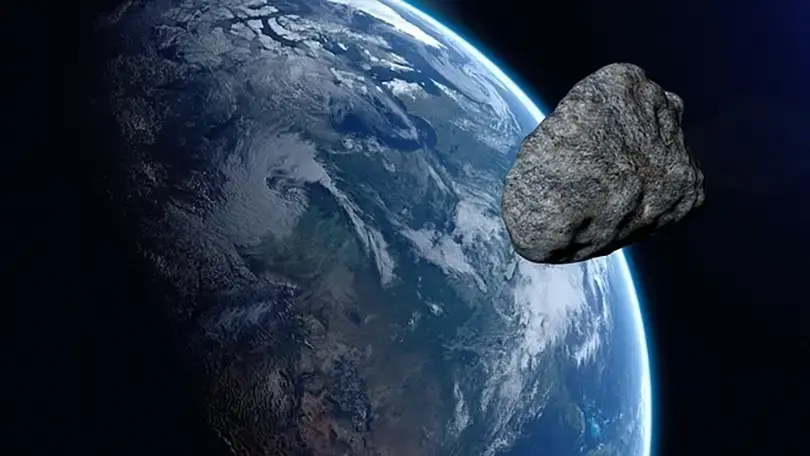
In science, there are rare moments when one event captures curiosity, concern, and global attention all at once. That is exactly what is happening now with the asteroid Apophis. Its name comes from an ancient Egyptian symbol of chaos, and somehow that feels fitting.
This space rock is about 370 meters wide, roughly the size of three football stadiums placed side by side. It has been traveling through space for millions of years, but in just a few years, it will pass extremely close to Earth. Close enough to become one of the most talked about cosmic events of our time.
According to NASA, Apophis is listed as a potentially hazardous asteroid. That sounds alarming, but the term has a specific scientific meaning. It simply describes objects that are large enough and pass relatively close to Earth. It does not mean impact is expected.
To understand how close this will be, think about the distance to the Moon, which is about 384000 kilometers. Apophis will pass much closer than that. In fact, it will move below the orbit of some satellites that support GPS, communications, and internet systems.
That is incredibly rare.
And this is where things get fascinating.
Modern science is no longer just watching space. It is learning how to predict and even respond to potential threats. Apophis has become one of the clearest examples of how humanity is shifting from passive observation to active planetary defense.
When Apophis was discovered in 2004, early calculations raised serious concern. At one point, the probability of impact in 2029 was considered notable by scientific standards. It quickly became one of the most closely monitored objects in space.
But as more data came in, scientists refined its trajectory. Today, researchers are confident that Apophis will not hit Earth in the coming decades. This is a crucial point that often gets lost in headlines. There is no immediate danger.
So why is everyone still talking about it
Because this event is unique. The flyby of Apophis will give scientists a rare opportunity to study a large asteroid up close. Not just through telescopes, but with advanced radar systems, detailed surface analysis, and possibly even dedicated space missions.
One of the most exciting aspects is gravity. As Apophis passes Earth, our planet will slightly change its path. Scientists will be able to observe this interaction in real time, almost like a natural experiment on a cosmic scale.
There is also something called the Yarkovsky effect. This is a tiny force caused by uneven heating from the Sun. Over long periods, it can shift an asteroid’s path. Apophis offers a perfect chance to test how accurate our models really are.
Still, the emotional question remains. What if
For the first time in history, humanity has the tools to potentially prevent an asteroid impact. In 2022, the DART mission successfully changed the orbit of a small asteroid. It proved that we are not powerless.
Apophis will not be a target for such missions because it is not a threat. But it will serve as a real world test for observation systems, coordination, and global response strategies.
There is also something powerful about the human side of this story. Millions of people may be able to see Apophis with the naked eye. It will not just be a distant object in a telescope. It will be visible, real, and impossible to ignore.
In the United States, interest is already growing beyond the scientific community. Media platforms, educators, and creators are preparing to explain what is happening and why it matters. Space is becoming part of everyday conversation again, but now with deeper understanding.
And maybe that is the most important part.
Apophis is not just a rock in space. It is a reminder. Our planet exists in a dynamic and sometimes unpredictable environment. But it is also a symbol of how far we have come.
We are no longer just looking at the sky. We are learning how to understand it, measure it, and one day, protect ourselves from it.
This is the shift from fear to knowledge.
Large asteroid impacts are extremely rare. Events like the one that ended the age of dinosaurs happen over tens of millions of years. But smaller objects can still cause regional damage, which is why research and preparation matter.
Apophis gives us a rare chance to get ready. Not in panic, but in calm, scientific focus.
When it passes Earth, it will not be the end of a story. It will be the beginning of a new chapter. One where humanity takes another step toward becoming a true spacefaring civilization.
This space rock is about 370 meters wide, roughly the size of three football stadiums placed side by side. It has been traveling through space for millions of years, but in just a few years, it will pass extremely close to Earth. Close enough to become one of the most talked about cosmic events of our time.
According to NASA, Apophis is listed as a potentially hazardous asteroid. That sounds alarming, but the term has a specific scientific meaning. It simply describes objects that are large enough and pass relatively close to Earth. It does not mean impact is expected.
To understand how close this will be, think about the distance to the Moon, which is about 384000 kilometers. Apophis will pass much closer than that. In fact, it will move below the orbit of some satellites that support GPS, communications, and internet systems.
That is incredibly rare.
And this is where things get fascinating.
Modern science is no longer just watching space. It is learning how to predict and even respond to potential threats. Apophis has become one of the clearest examples of how humanity is shifting from passive observation to active planetary defense.
When Apophis was discovered in 2004, early calculations raised serious concern. At one point, the probability of impact in 2029 was considered notable by scientific standards. It quickly became one of the most closely monitored objects in space.
But as more data came in, scientists refined its trajectory. Today, researchers are confident that Apophis will not hit Earth in the coming decades. This is a crucial point that often gets lost in headlines. There is no immediate danger.
So why is everyone still talking about it
Because this event is unique. The flyby of Apophis will give scientists a rare opportunity to study a large asteroid up close. Not just through telescopes, but with advanced radar systems, detailed surface analysis, and possibly even dedicated space missions.
One of the most exciting aspects is gravity. As Apophis passes Earth, our planet will slightly change its path. Scientists will be able to observe this interaction in real time, almost like a natural experiment on a cosmic scale.
There is also something called the Yarkovsky effect. This is a tiny force caused by uneven heating from the Sun. Over long periods, it can shift an asteroid’s path. Apophis offers a perfect chance to test how accurate our models really are.
Still, the emotional question remains. What if
For the first time in history, humanity has the tools to potentially prevent an asteroid impact. In 2022, the DART mission successfully changed the orbit of a small asteroid. It proved that we are not powerless.
Apophis will not be a target for such missions because it is not a threat. But it will serve as a real world test for observation systems, coordination, and global response strategies.
There is also something powerful about the human side of this story. Millions of people may be able to see Apophis with the naked eye. It will not just be a distant object in a telescope. It will be visible, real, and impossible to ignore.
In the United States, interest is already growing beyond the scientific community. Media platforms, educators, and creators are preparing to explain what is happening and why it matters. Space is becoming part of everyday conversation again, but now with deeper understanding.
And maybe that is the most important part.
Apophis is not just a rock in space. It is a reminder. Our planet exists in a dynamic and sometimes unpredictable environment. But it is also a symbol of how far we have come.
We are no longer just looking at the sky. We are learning how to understand it, measure it, and one day, protect ourselves from it.
This is the shift from fear to knowledge.
Large asteroid impacts are extremely rare. Events like the one that ended the age of dinosaurs happen over tens of millions of years. But smaller objects can still cause regional damage, which is why research and preparation matter.
Apophis gives us a rare chance to get ready. Not in panic, but in calm, scientific focus.
When it passes Earth, it will not be the end of a story. It will be the beginning of a new chapter. One where humanity takes another step toward becoming a true spacefaring civilization.
And maybe moments like this are exactly what define our future.