





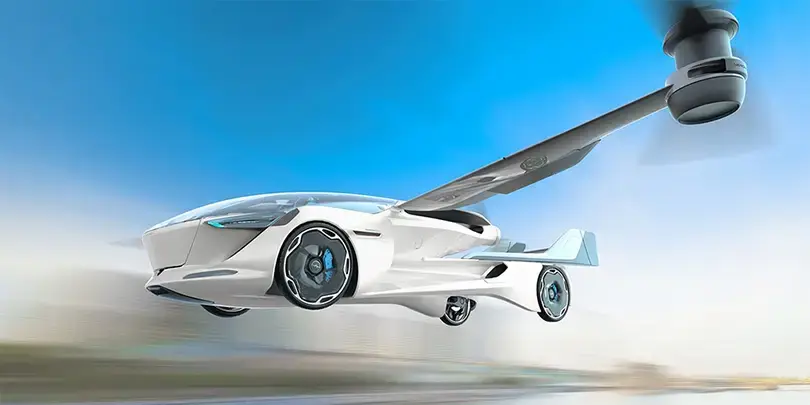
The world is holding its breath again. Elon Musk has hinted that Tesla may introduce a flying car in the near future — and while that sounds like something out of science fiction, it’s exactly the kind of idea that usually turns into reality when Musk is involved.
From the Road to the Sky
Over the past two decades, Musk has repeatedly rewritten the rules — from electric vehicles to private space travel. Now he seems ready to merge both worlds: Tesla and SpaceX.
According to Musk, the company is exploring lightweight designs and next-generation batteries that could make a new kind of vehicle possible — a hybrid between a car and a vertical takeoff aircraft.
“We already know how to make high-density batteries and superlight structures,” Musk said recently. “The hard part is safety and noise. People have to actually want this flying above their homes.”
As always, one short quote was enough to ignite a storm of discussion — from excitement to skepticism. But history shows that the ideas everyone calls “impossible” are usually the ones Musk decides to make real.
Why the Flying Car Idea Is Back
The dream of personal flying vehicles has been around since the early days of aviation. In the 1950s, engineers in the U.S. imagined “cars of the future” with wings that could be folded away at home. But back then, weight, power, and cost made those dreams impractical.
Today, the picture is different. The technologies Tesla has been developing for years — electric motors, powerful batteries, autonomous navigation, and composite materials — open entirely new possibilities.
The biggest challenge is energy. To take off vertically, a vehicle needs far more power than a car. But Tesla’s latest battery cells, the 4680s, deliver much higher energy density, bringing the idea closer to reality.
And if Tesla borrows from SpaceX — using lightweight carbon structures, aerodynamic design, and advanced guidance systems — a flying Tesla no longer sounds like fantasy.
What a Flying Tesla Might Look Like
Experts believe it wouldn’t be a regular car with wings, but an electric eVTOL — a small aircraft that takes off and lands vertically, like a drone, but designed for two or four passengers.
Companies like Joby Aviation, Lilium, and XPeng are already developing similar vehicles. Yet if Tesla joins the race, it could change everything — thanks to its strength in mass production, software, and AI integration.
Imagine this: a fully autonomous aerial vehicle. You enter your destination, sit back, and the system handles everything — navigation, flight path, and landing.
If Tesla applies its signature style from the Model S or Cybertruck, this aircraft would likely be sleek, quiet, all-electric, and connected to Tesla’s entire ecosystem — from chargers to the mobile app.
The Hard Part Isn’t Building It
As Musk himself noted, “The hardest part isn’t building a flying car. The hardest part is making it legal to fly.”
Airspace regulations are among the strictest in the world. Any new aircraft has to prove its safety — not just for passengers, but for everyone below. Then there’s noise, range, and cost.
For that reason, the first flying Tesla — if it appears — probably won’t be a mass-market product. It will be a demonstration model, a proof of concept that redefines what personal transport can be.
Musk’s Pattern: From Dream to Reality
Look back and a clear pattern emerges. Almost every idea Musk has announced — from affordable electric cars to reusable rockets — was first dismissed as impossible.
Model S proved electric cars could be fast and desirable. Falcon 9 made spaceflight reusable. Starlink brought internet to remote places. Neuralink is connecting the brain to computers.
So why not believe that personal flight could be next?
Musk’s strength lies in turning radical visions into working technology — and doing it before anyone else dares to try. His philosophy has always been simple: don’t wait for the world to be ready; make it ready.
What Comes Next
There are no official details yet, but insiders already speculate that the first prototype could be called Tesla Air or Model A, a nod to its aviation ambitions.
It’s also possible that SpaceX engineers will collaborate on stabilization and flight control systems.
Even if the first real flight is still years away, the fact that Musk mentioned it publicly has already shaken the industry. Stocks of eVTOL companies rose, and analysts are calling it the next frontier in urban mobility.
Beyond Cars — a New Way of Moving
The Tesla flying car isn’t just another futuristic gadget. It’s a symbol of how technology keeps pushing the limits of what’s possible — a bridge between earth and sky, between engineering and imagination.
Maybe we’re living in the decade when kids who grew up watching Back to the Future will finally see that iconic moment when a car truly takes off.
And when it does, chances are it’ll have one very familiar logo — the sleek letter “T” that stands for Tesla.