





California has a history of spotting big shifts early. When electric cars took off, it started here. When AI exploded, it started here. Now another shift is unfolding.
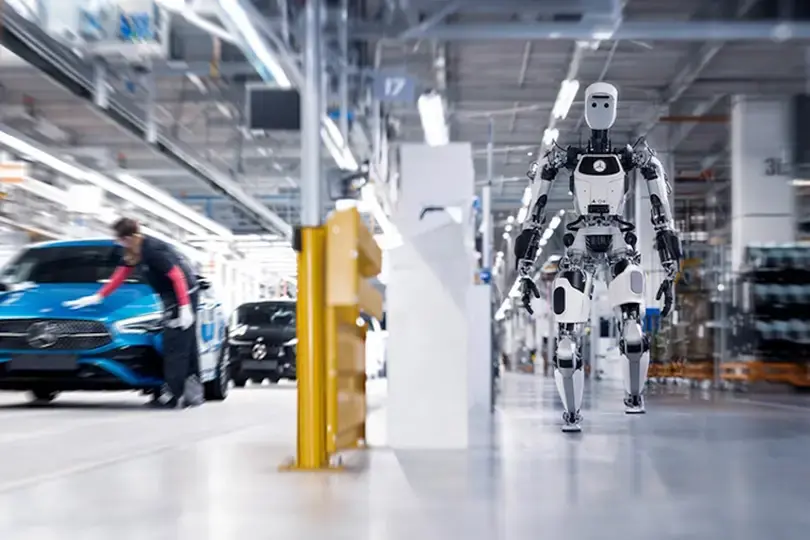
A humanoid robot named Apollo is stepping onto warehouse floors and factory sites. Not as a demo. Not as a lab experiment. As a real worker.
The company behind it, Apptronik, recently raised 520 million dollars at a 5 billion dollar valuation. The project is backed by Google and Mercedes-Benz. That kind of support sends a clear signal. This is not hype. This is strategy.
Not Just a Robot. A New Type of Worker.
Apollo is about 5 feet 8 inches tall and weighs around 160 pounds. It can lift up to 55 pounds and works for about four hours on a battery. The battery can be swapped in seconds, so work does not stop.
But hardware is not the real story. The real story is intelligence.
Apollo runs on AI systems connected to Gemini models, developed with help from Google DeepMind. That means the robot can understand spoken instructions. It can watch a human demonstrate a task. It can plan several steps ahead. It can handle objects it has never seen before.
In robotics research, this is called adaptive behavior. Instead of following a rigid script, the machine reacts to context. That changes everything.
Why This Matters for California
California is a logistics powerhouse. Ports in Southern California feed goods into warehouses across the Inland Empire and beyond. E commerce keeps growing. At the same time, companies face labor shortages, rising wages, and constant pressure to move faster.
Studies in industrial automation show that flexible robotic systems can reduce delays by up to 30 percent and improve workflow stability. That is not theory. That is measurable performance.
Apollo is already working in controlled areas at partner facilities including Mercedes-Benz, GXO Logistics, and Jabil. It unloads trailers. It moves parts across production floors. It supports order picking and palletizing.
This is not a stage performance. It is operational deployment.
Designed to Work With People
Traditional industrial robots are usually locked behind cages. Humans stay out. Machines stay in.
Apollo follows a different philosophy. It is built to work around people.
The robot has built in safety zones. If it detects something too close, it slows or stops. LED signals on its head and chest show its status clearly. That reduces uncertainty and builds trust.
Its humanlike shape is not cosmetic. Warehouses and factories were built for humans. Doorways, tools, carts, and shelves all match human size. A humanoid robot fits into existing spaces without expensive redesign.
From an engineering perspective, this lowers the barrier to adoption. Companies do not need to rebuild their infrastructure. They integrate a new worker into the current one.
The Economics Are Clear
Five hundred twenty million dollars in funding is not a small bet. Investors are not backing a toy. They are betting on scale.
Apptronik was founded in 2016 out of the University of Texas. Years of research in human centered robotics led to this point. Now the company is preparing a new version of Apollo and aiming for broader deployment.
The key advantage is flexibility. Traditional automation works best when tasks never change. But warehouses are dynamic. Product lines shift. Packaging changes. Demand spikes.
A humanoid with AI can adapt through software updates and training from demonstration. That makes the investment more future proof.
The Global Race
The race for humanoid robots is heating up. Companies in China are moving fast. Tesla is developing its own humanoid platform. Everyone wants to define the next generation of industrial labor.
The winner will not be the company with the flashiest demo. It will be the one with the first scalable, reliable, and commercially viable product.
Apollo is positioning itself exactly there.
Beyond Warehouses
Today the focus is on logistics and manufacturing. Tomorrow it could be construction, energy, electronics assembly, retail, and even elder care.
California, with its aging population and strong tech ecosystem, may become one of the main testing grounds for this transition.
But the warehouse is the proving ground. It offers clear metrics, repeatable tasks, and immediate economic return.
Not Replacement. Reconfiguration.
Every time automation evolves, fear follows. But history shows something more complex. Automation shifts work. It does not simply erase it.
As humanoid robots spread, new roles will grow. Robot operators. AI trainers. Maintenance specialists. Integration engineers.
Apollo can operate autonomously or connect to continuous power. It can stand on fixed platforms or move using legs. It can use standard tools. It can navigate spaces built for people.
The real question for California businesses is not whether robots will arrive. They already have.
The real question is who will learn fastest how to build teams where humans and humanoids work side by side.
Because the future of work is not human versus machine. It is human plus machine.