





California Schools Are Putting Smartphones Away: What Has Changed for Students and Parents
Not long ago, a phone in a school backpack felt completely normal. Parents texted their children between classes, teenagers checked notifications during breaks, and teachers kept asking students to put their screens away. Now the routine is changing in many California schools. A smartphone may have to stay turned off inside a backpack, remain in a designated storage area, or be locked in a pouch until the school day ends.
As of July 1, 2026, every public school district, county office of education, and charter school in California must have a policy that limits or prohibits student smartphone use on campus or while students are under school supervision. The requirement comes from AB 3216, known as the Phone Free Schools Act.
This is a major change for families, but it is easy to misunderstand. California has not created one identical ban for every student. Local school boards can decide how strict the rules will be, where devices must be stored, and when a student may use one.
There Is No Single Rule for Every School
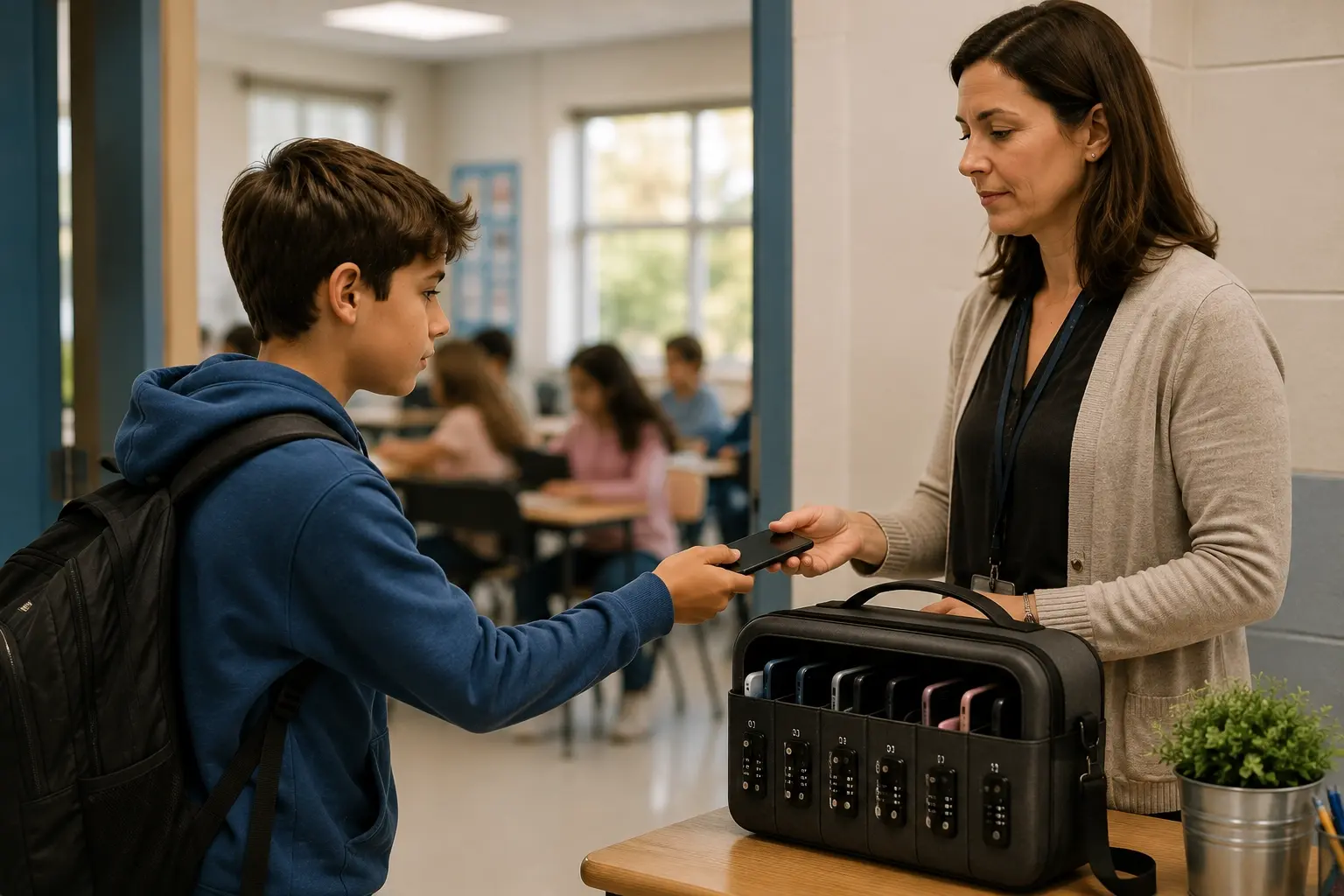
In one district, students may be allowed to bring a phone as long as it stays turned off and out of sight during class. In another, phones may be unavailable from the first bell to the last, including lunch and passing periods. Some schools use locking pouches. Students place their phones inside in the morning and cannot open the pouch until the school day is over.
Other schools take a less restrictive approach. They may prohibit phones during lessons but allow them at lunch. Some districts use lockers, classroom storage containers, or rules requiring devices to remain turned off and out of sight. Parents need to check the policy of their specific district and school, not only the statewide law.
Why Schools Are Limiting Smartphones
The main concern will sound familiar to almost every teacher. Silent mode does not always solve the problem. A notification on the screen, a quick reply in a group chat, or the urge to check social media can break a student’s attention. Returning fully to the lesson takes time.
School leaders hope the new limits will reduce distractions, encourage more face to face conversation, and prevent conflicts from spreading through group chats and social media during the school day. Younger children may spend more time playing and talking during breaks. Teenagers may get a clearer boundary between school and the constant flow of messages.
The scientific picture calls for balance. Research links frequent smartphone checking during the school day with weaker cognitive control, which is important for learning and self regulation. At the same time, research on school phone restrictions has not consistently shown better mental health or academic results. A policy alone is not enough. The outcome depends on clear rules, consistent enforcement, family communication, and the way the school responds to individual needs.
What Parents Are Worried About
The most common concern is safety. Many parents want to reach their child immediately during a fire, a threat on campus, or another emergency. After years of treating a phone as a safety tool, making it unavailable for several hours can feel unsettling.
Schools often explain that many calls at once can overload communication, spread unverified information, and make it harder for students to follow emergency instructions. Official updates are generally expected to come from the school or district. Families may still question whether those alerts will arrive quickly enough.
Parents should learn how their school sends emergency notifications, which number to call with an urgent message, and who can deliver that message to a student. If phones are stored in locking pouches, families should also ask where the pouches can be opened and who has access to the unlocking equipment.
Which Exceptions Are Allowed
The rules should not prevent a student from getting necessary help. California law provides exceptions for emergencies, medical needs, and situations in which a teacher or school administrator authorizes smartphone use. Separate accommodations may apply to students with an Individualized Education Program, commonly called an IEP, or a Section 504 plan.
A student may need a phone to monitor a medical device or health condition. In that situation, a family should not rely only on a verbal agreement with one teacher. The need should be documented through the administration, school nurse, IEP, or Section 504 plan. This helps prevent a phone from being taken away when the student truly needs it.
What Is Happening Across Different Districts
The new school year is showing how differently the law can be applied. Some Bay Area schools are using rules that cover the entire day and require locking pouches. Other districts allow phones to remain turned off and out of sight. San Francisco continues to discuss stricter options while its current policy already limits device use during the instructional day.
Two neighboring schools may therefore have very different expectations. One teenager may be allowed to check a phone at lunch, while a friend in the next district may not have access until dismissal. That does not automatically mean one school is breaking the law. AB 3216 requires a restrictive policy, but local education leaders still have considerable freedom to choose the details.
How to Prepare Your Child
The first step is to read the policy of the actual school. It may appear on the district website, in the student handbook, or in a message sent before classes begin. Look for the hours when restrictions apply, the required storage method, the consequences for repeated violations, and the emergency communication process.
Families can also create a simple communication plan. Urgent matters go through the school office. Routine messages wait until dismissal. The child checks in at an agreed time after school. This can reduce parental anxiety and help students avoid secretly checking a phone because they are afraid of missing an important message.
A Phone Free School or a New Kind of Responsibility
The debate often moves between two extremes. Some people treat smartphones as the source of every school problem. Others see any restriction as a threat to a child’s safety and independence. The truth is more complicated. A phone can help a family stay connected, but it can also interrupt concentration, increase social media pressure, and move school conflicts onto a screen in real time.
The new law does not settle that debate for parents and teachers. It requires every school system to create clear rules and take responsibility for how they are enforced. The real question is not simply whether a student loses access to a phone. It is whether the school can maintain safe communication, respect medical needs, and apply the rules fairly to every child.
As of July 1, 2026, every public school district, county office of education, and charter school in California must have a policy that limits or prohibits student smartphone use on campus or while students are under school supervision. The requirement comes from AB 3216, known as the Phone Free Schools Act.
This is a major change for families, but it is easy to misunderstand. California has not created one identical ban for every student. Local school boards can decide how strict the rules will be, where devices must be stored, and when a student may use one.
There Is No Single Rule for Every School
In one district, students may be allowed to bring a phone as long as it stays turned off and out of sight during class. In another, phones may be unavailable from the first bell to the last, including lunch and passing periods. Some schools use locking pouches. Students place their phones inside in the morning and cannot open the pouch until the school day is over.
Other schools take a less restrictive approach. They may prohibit phones during lessons but allow them at lunch. Some districts use lockers, classroom storage containers, or rules requiring devices to remain turned off and out of sight. Parents need to check the policy of their specific district and school, not only the statewide law.
Why Schools Are Limiting Smartphones
The main concern will sound familiar to almost every teacher. Silent mode does not always solve the problem. A notification on the screen, a quick reply in a group chat, or the urge to check social media can break a student’s attention. Returning fully to the lesson takes time.
School leaders hope the new limits will reduce distractions, encourage more face to face conversation, and prevent conflicts from spreading through group chats and social media during the school day. Younger children may spend more time playing and talking during breaks. Teenagers may get a clearer boundary between school and the constant flow of messages.
The scientific picture calls for balance. Research links frequent smartphone checking during the school day with weaker cognitive control, which is important for learning and self regulation. At the same time, research on school phone restrictions has not consistently shown better mental health or academic results. A policy alone is not enough. The outcome depends on clear rules, consistent enforcement, family communication, and the way the school responds to individual needs.
What Parents Are Worried About
The most common concern is safety. Many parents want to reach their child immediately during a fire, a threat on campus, or another emergency. After years of treating a phone as a safety tool, making it unavailable for several hours can feel unsettling.
Schools often explain that many calls at once can overload communication, spread unverified information, and make it harder for students to follow emergency instructions. Official updates are generally expected to come from the school or district. Families may still question whether those alerts will arrive quickly enough.
Parents should learn how their school sends emergency notifications, which number to call with an urgent message, and who can deliver that message to a student. If phones are stored in locking pouches, families should also ask where the pouches can be opened and who has access to the unlocking equipment.
Which Exceptions Are Allowed
The rules should not prevent a student from getting necessary help. California law provides exceptions for emergencies, medical needs, and situations in which a teacher or school administrator authorizes smartphone use. Separate accommodations may apply to students with an Individualized Education Program, commonly called an IEP, or a Section 504 plan.
A student may need a phone to monitor a medical device or health condition. In that situation, a family should not rely only on a verbal agreement with one teacher. The need should be documented through the administration, school nurse, IEP, or Section 504 plan. This helps prevent a phone from being taken away when the student truly needs it.
What Is Happening Across Different Districts
The new school year is showing how differently the law can be applied. Some Bay Area schools are using rules that cover the entire day and require locking pouches. Other districts allow phones to remain turned off and out of sight. San Francisco continues to discuss stricter options while its current policy already limits device use during the instructional day.
Two neighboring schools may therefore have very different expectations. One teenager may be allowed to check a phone at lunch, while a friend in the next district may not have access until dismissal. That does not automatically mean one school is breaking the law. AB 3216 requires a restrictive policy, but local education leaders still have considerable freedom to choose the details.
How to Prepare Your Child
The first step is to read the policy of the actual school. It may appear on the district website, in the student handbook, or in a message sent before classes begin. Look for the hours when restrictions apply, the required storage method, the consequences for repeated violations, and the emergency communication process.
Families can also create a simple communication plan. Urgent matters go through the school office. Routine messages wait until dismissal. The child checks in at an agreed time after school. This can reduce parental anxiety and help students avoid secretly checking a phone because they are afraid of missing an important message.
A Phone Free School or a New Kind of Responsibility
The debate often moves between two extremes. Some people treat smartphones as the source of every school problem. Others see any restriction as a threat to a child’s safety and independence. The truth is more complicated. A phone can help a family stay connected, but it can also interrupt concentration, increase social media pressure, and move school conflicts onto a screen in real time.
The new law does not settle that debate for parents and teachers. It requires every school system to create clear rules and take responsibility for how they are enforced. The real question is not simply whether a student loses access to a phone. It is whether the school can maintain safe communication, respect medical needs, and apply the rules fairly to every child.
For parents, the new school year will be a practical test of the system. Save a copy of the school policy, confirm your contact information in the emergency alert system, and talk with your child about what to do without constant access to a screen.